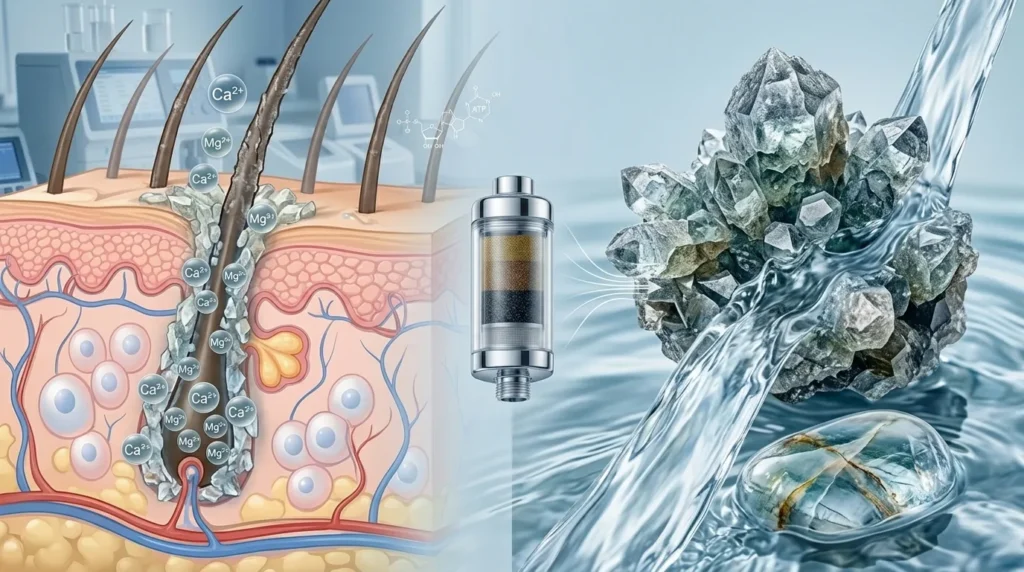
If you regularly wash your hair in a high-mineral municipal water zone, you might be experiencing a frustrating symptom that standard anti-dandruff shampoos cannot fix: a persistent, gritty, white film on your scalp that scratches off under your fingernails.
Many people mistake this for severe dry scalp, dandruff, or product buildup. However, if your scalp constantly itches, feels tight immediately after a shower, or exhibits small, acne-like bumps around the hair follicles, you are likely dealing with scalp calcification.
This condition occurs when dissolved calcium and magnesium ions chemically bind with your body’s natural oils, building a crystalline mineral mask over your skin. Here is the clinical science behind hard water scalp calcification, and the exact step-by-step protocol required to break the crust and restore your skin barrier.
🔬 The Science: How Water Turns into Scalp Crust
Scalp calcification is a two-step chemical process that happens right at the mouth of your hair follicles:
1. The Saponification Reaction (Soap Scum Creation)
When the calcium carbonate (CaCO3) and magnesium sulfate (MgSO4) dissolved in hard water mix with the fatty acids in your shampoo or your scalp’s natural sebum, an insoluble chemical reaction occurs. Instead of rinsing away cleanly, it creates a sticky, waxy substance known as calcium salt—the exact same material that forms “soap scum” rings around your bathtub.
2. Crystalline Layering
As you continue to shower week after week, these microscopic salt residues layer on top of each other. The high heat of your shower water evaporates the liquid, leaving behind a hardened, calcified mineral shield. This film acts like plastic wrap over your head, trapping dead skin cells, environmental pollution, and malicious yeast (like Malassezia) directly against your skin.
[Hard Water Minerals + Sebum] ➔ [Insoluble Calcium Salts] ➔ [Pore Clogging Mineral Shield] ➔ [Scalp Calcification & Itch]
⚠️ The Warning Signs of Mineral Scalp Suffocation
When your scalp barrier is buried under mineral scale, it undergoes serious physiological stress:
- The Chronic Hard Water Itch: Hard water has a high, alkaline pH. Your scalp thrives in a slightly acidic environment ($pH\ 4.5\ to\ 5.5$) to protect its microbiome. The alkaline minerals disrupt this acidity, causing a tight, prickling sensation and constant itching right after you step out of the shower.
- Follicle Occlusion (Scalp Acne): The calcified film physically blocks your pores. Sebum gets trapped underneath the mineral layer, creating painful, inflamed bumps around the hair root, a condition known as mineral-induced folliculitis.
- Diffused Thinning: As the mineral crust hardens around the mouth of the follicle, it constricts the hair shaft. Over months of exposure, this lack of oxygen and persistent micro-inflammation can weaken the hair root, leading to accelerated shedding and thinning.
🛠️ The 3-Step Decalcification Protocol
You cannot scrub calcification away with regular soap; raw friction will only irritate your compromised skin barrier further. You must dissolve the mineral bonds chemically and protect your skin from future buildup.
Step 1: Chemical Dissolution (The Acidic Breakdown)
To break down hardened calcium deposits, you must lower the pH on your scalp to dissolve the mineral crystals. Use a specialized chelating shampoo containing Disodium EDTA or a targeted Apple Cider Vinegar (ACV) scalp rinse once a week. Let the solution sit on your scalp for 3 to 5 minutes to chemically unlock the calcium bonds, then gently massage with a soft silicone scalp brush.
Step 2: Clear Past Buildup
If you have years of mineral buildup, match your chelating wash with a dedicated, pH-balanced clarifying shampoo. Read our detailed guide on the Best Shampoos for Waxy Hard Water Hair to pick a formula that safely lifts calcium scale without stripping away the essential lipid barrier your skin needs to heal.
Step 3: Stop the Inflow at the Source
Decalcifying your scalp is a losing battle if you continue to dump gallons of liquid rock onto your head every morning. A standard showerhead filter engineered with a high-quality KDF-55 copper-zinc matrix is required to alter the crystal structure of the incoming minerals, preventing them from plating onto your skin ever again. Explore our lab testing reviews of the 3 Best Shower Filters for Hard Water to find a budget-friendly option for your bathroom.