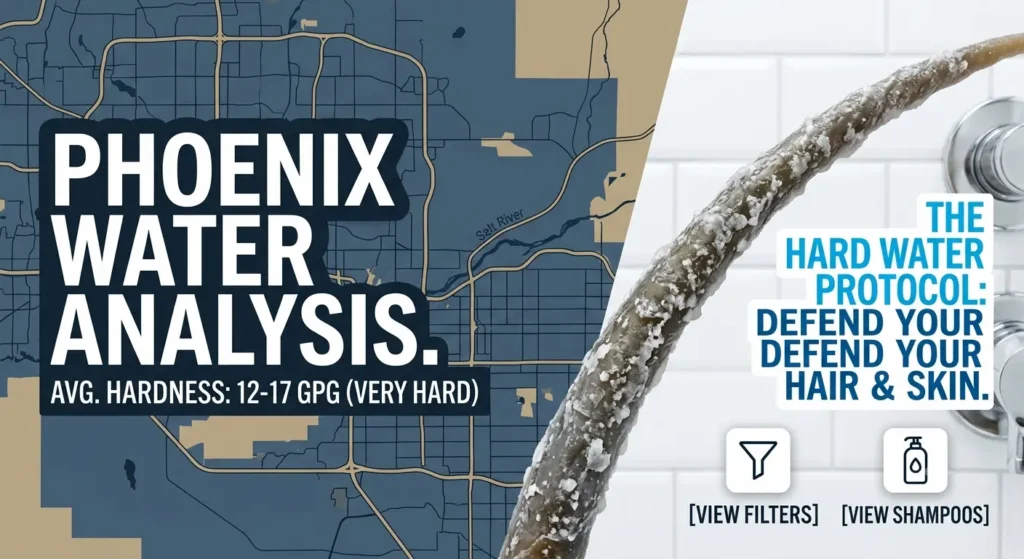
If you live in the Phoenix metropolitan area—whether in downtown Phoenix, Scottsdale, Tempe, or Mesa—you are bathing in some of the most aggressive municipal water in the United States.
Residents consistently notice that within weeks of moving to the Valley of the Sun, their hair transforms into a stiff, straw-like texture, curls lose their definition, and their scalp begins to itch chronically.
This isn’t a coincidence, nor is it a problem with your hair care products. It is the direct chemical result of the unique geological makeup of Arizona’s water supply. Here is a transparent look at the data behind Phoenix tap water, exactly what it does to your body, and the scientific protocol required to fix it.
📊 The Local Data: Just How Hard is Phoenix Water?
Water hardness is measured either in Parts Per Million (PPM) or Grains Per Gallon (GPG). According to the U.S. Geological Survey (USGS), any water measuring over 10.5 GPG is classified as “Very Hard.”
According to municipal data from the Phoenix Water Services Department, sampled water hardness levels consistently range from 12 to 17 grains per gallon (GPG). In surrounding suburbs like Scottsdale or Goodyear, spikes can climb well over 20 GPG.
[Soft Water: <3.5 GPG] ➔ [Hard Water: 7-10.5 GPG] ➔ [PHOENIX WATER: 12-17+ GPG]
Because the desert Southwest has exceptionally high mineral counts, standard manufacturer guidelines won’t apply to you. In fact, extreme municipal water can cut a cartridge’s lifespan in half. See our data breakdown on [filter media saturation vs. hard water PPM levels] to estimate your real timeline.”
Why is it so intense?
The majority of Phoenix’s water originates from mineral-rich surface reservoirs like the Salt River and Verde River, alongside deep desert groundwater wells. As this water travels through thousands of miles of arid limestone and mineral-heavy soil, it dissolves massive volumes of calcium, magnesium, and heavy metals along the way. By the time it reaches your showerhead, it is saturated with dissolved rock.
⚡ Chemical Analysis: The Double Whammy on Hair
Phoenix water attacks your hair and skin through two specific chemical pathways:
1. Calcium Sulfite & Magnesium Mineral Plating
Because the mineral concentration is so far past the saturation point, the moment hot water hits your hair, the calcium and magnesium ions undergo a temperature-induced phase change. They physically bind to the negatively charged protein bonds (keratin) of your hair shaft. This forms a literal crystalline rock shield over your hair strand, locking moisture out and preventing your moisturizing conditioners from ever penetrating.
2. High Residual Chlorine High-Heat Bleaching
To keep municipal water safe across a massive, scorching desert infrastructure, the city safely utilizes intensive chlorine disinfection. While essential for public health, showering in hot, chlorinated water strips away the sebum—the natural oil layer protecting your hair cuticle. Combined with the heavy minerals, this creates a harsh environment that rapidly fades color-treated hair and induces scalp inflammation.
🛡️ The Phoenix Hair Restoration Protocol
If you are tired of dealing with sticky, unmanageable hair, you cannot fix this by simply buying more expensive moisturizers. You must remove the minerals and protect the strand. Follow this simple two-step protocol:
Step 1: Intercept the Minerals at the Source
A standard apartment showerhead cannot cope with Arizona’s high mineral output. You must install an inline filtration system containing a high-purity copper-zinc matrix to alter the scale before it hits your head. Review our independent lab breakdown of the Best Shower Filters for Hard Water to select a system capable of handling 15+ GPG without restricting your water pressure.
Step 2: Use an Active Chelating Agent
Regular clarifying shampoos are useless against desert scale. You need a dedicated formula containing chelating molecules (like Disodium EDTA or Vitamin C) that chemically lock onto calcium and pull it off the hair protein. Read our definitive user guide on the Best Hard Water Shampoos to safely break the waxy buildup without stripping your hair’s natural hydration.