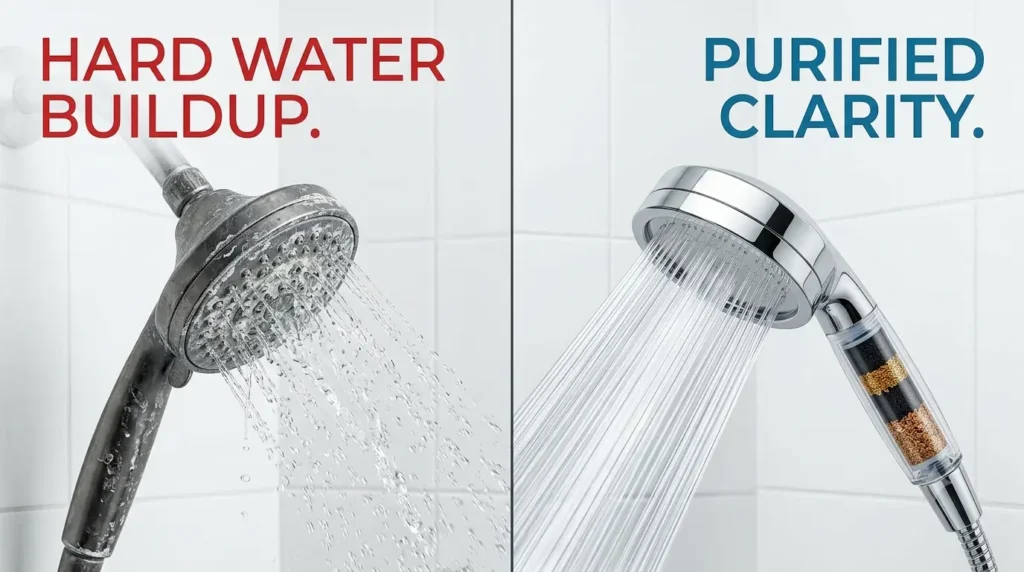
You bought a high-quality shower filter, installed it, and watched your hair transform from a straw-like, sticky mess back to its naturally vibrant self. You did the heavy lifting to protect your scalp barrier from harsh municipal minerals.
But right now, inside your shower head, a silent countdown is ticking away.
Most manufacturers print a generic, optimistic guideline on the box: “Replace every 6 months.” But water chemistry doesn’t care about calendar dates. Depending on your local water hardness, your family size, and your daily shower habits, that filter cartridge could be completely saturated and non-functional by month three—or it might stretch to month seven.
If you miss the expiration window, you aren’t just showering in hard water again; you are showering through a saturated block of trapped minerals, sediment, and chemical bypass. Here is the data-driven, independent guide to diagnosing the exact state of your filter cartridge before your hair and scalp pay the price.
The Science of Filter “Breakthrough”: Why 6 Months Is a Myth
Shower filters do not work like a kitchen sieve that simply catches dirt until it overflows. High-quality systems use specialized chemical media like KDF-55 (Kinetic Degradation Fluxion) and Calcium Sulfite to alter the molecular structure of dissolved minerals and neutralize chlorine through an electron exchange.
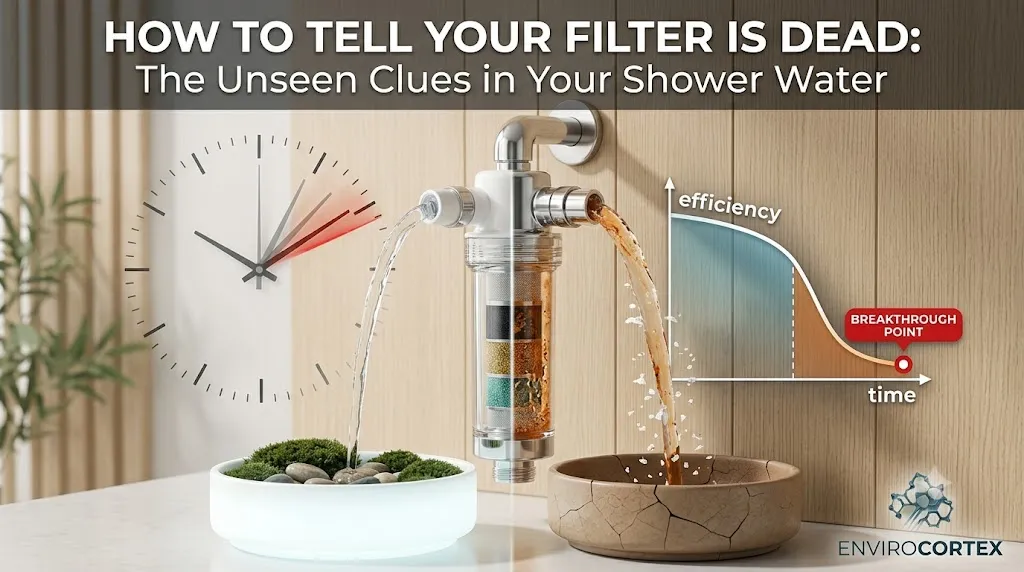
Over time, this media reaches what water treatment engineers call the breakthrough point.
What is Breakthrough? This occurs when the active chemical sites within the filtration media are completely bound to minerals (like calcium and magnesium) or degraded by chlorine. Once saturated, the media cannot capture any more contaminants. The water simply carves a path straight through the cartridge, carrying 100% of the hard water deposits directly onto your skin.
Because water hardness varies wildly from city to city, relying on a fixed calendar date is a gamble. Instead, you need to look for the biological and physical warning signs.
5 Warning Signs Your Filter Cartridge Has Failed
1. The Return of the “Sticky Hair” Syndrome
When your filter is fresh, your shampoo lathers into a rich, pillowy foam because the water lacks the heavy metallic ions that bind to soap molecules. The moment your cartridge hits its breakthrough point, those minerals return. If you suddenly notice your shampoo flatlining, requiring twice as much product to lather, or if your hair has that frustratingly familiar waxy, sticky coating right out of the shower, your filter is no longer neutralizing the mineral load.
2. A Creeping Return of Scalp Itch and Flaking
Hard water minerals don’t just coat your hair; they bind with your skin’s natural sebum to create an insoluble mineral crust. If you’ve previously cleared up your hard water scalp calcification, a sudden, unexplained return of a tight, itchy, or dry scalp is a glaring indicator that chlorine and calcium carbonate are breaking through the barrier again.
3. A Noticeable Drop in Water Pressure
As sediment, rust, and heavy mineral particulates are physically trapped by the pre-filter stages of your cartridge, the microscopic pores begin to choke. If your once-powerful shower stream has degraded into a sluggish drizzle, the cartridge is physically clogged. While frustrating, this is actually a sign the filter did its job—it is simply full and demands an immediate swap.
4. The Re-emergence of the “Pool Smell” (Chlorine)
Chlorine gas vaporizes rapidly in hot water, creating a distinct, sharp chemical odor in a closed shower stall. High-quality Calcium Sulfite or KDF media removes up to 99% of this chlorine instantly. If you step into your morning shower and sniff even a faint hint of a public swimming pool, the chemical-neutralizing properties of your cartridge are completely spent.
5. Dull, Fading Hair Color and Brittle Ends
If you dye your hair and notice your expensive salon color fading or turning brassy weeks ahead of schedule, hard water oxidation is back at work. Unfiltered copper, iron, and chlorine act as oxidizing agents that strip hair cuticles, forcing the hair shaft open and allowing moisture to escape.
Lifespan Reality Check: Filter Media vs. Hardness Levels
To give you an accurate baseline, look at how different filtration materials handle varying levels of water quality. Do not wait for the 6-month mark if your household falls into the high-use or high-hardness categories.
| Filter Media Type | Ideal Target Contaminants | Actual Saturated Lifespan (Moderate Water: <120 PPM) | Actual Saturated Lifespan (Very Hard Water: >180 PPM) |
|---|---|---|---|
| Pure KDF-55 & Calcium Sulfite | Chlorine, Heavy Metals, Scale Control | 6 – 8 Months | 3 – 4 Months |
| Multi-Stage (Carbon, Ceramic, KDF Blend) | Chlorine, Odor, Fine Sediment | 4 – 6 Months | 2 – 3 Months |
| Vitamin C (Ascorbic Acid) Inline | Chloramines, Chlorine | 1 – 2 Months (Highly dependent on water temp) | 1 Month (Fast degradation in hard water) |
The Proactive Maintenance Protocol
To ensure you never experience a single day of hard water relapse, establish a strict diagnostic protocol:
- Track Your Household Volume: A single person showering once a day will get double the lifespan out of a cartridge compared to a family of three. Calculate your replacement cycle based on usage, not just the calendar.
- Keep a Spare On Hand: Never wait until your hair feels ruined to order a replacement. Keep at least one universal replacement cartridge in your bathroom cabinet at all times.
- Perform the Visual Inspection: Every 3 months, twist open your shower filter housing. If the internal mesh screen or sediment layer is dark brown, orange (from iron/rust), or covered in a white chalky film, discard it immediately.
By staying ahead of the breakthrough point, you keep your shower water pristine, your scalp barrier unbroken, and your hair wellness routine completely optimized.